

Constitutional Challenge Threatens Federal Marijuana Rescheduling Efforts
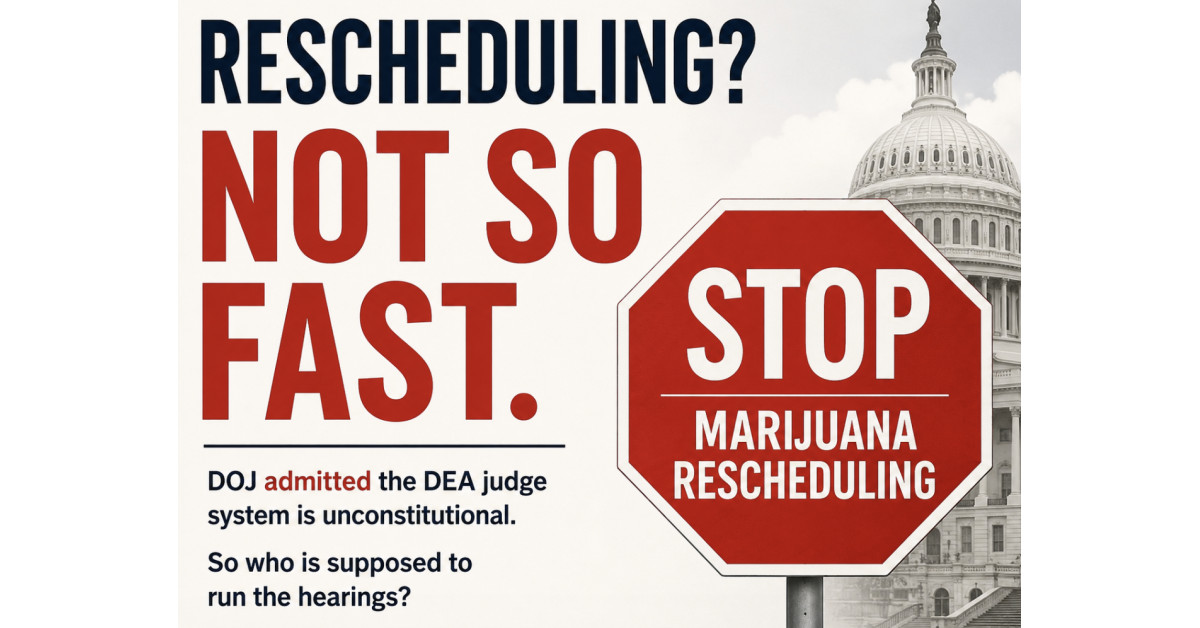
In May 2026, the federal government’s plan to move marijuana from Schedule I to Schedule III of the Controlled Substances Act ran into a legal roadblock that political momentum alone cannot overcome. The Department of Justice (DOJ) has publicly conceded that the administrative law judge (ALJ) structure used by the Drug Enforcement Administration (DEA) violates the U.S. Constitution, even as it prepares to hold rescheduling hearings before that same tribunal.
The DOJ’s Formal Concession
On February 27, 2025, the DOJ filed a Notice of Change of Position in the case MMJ BioPharma Cultivation Inc. v. Bondi (Civil Action No. 1:24‑cv‑127‑WES‑PAS, D.R.I.). In that filing the government stated unequivocally:
“the multiple layers of removal restrictions for administrative law judges (‘ALJs’) in 5 U.S.C. § 7521 do not comport with the separation of powers and Article II.”
By abandoning its defense of the DEA ALJ framework, the DOJ acknowledged a structural defect that could invalidate any proceedings conducted before those judges.
Why the ALJ Structure Matters for Rescheduling
Under the Controlled Substances Act, rescheduling a substance cannot be accomplished by executive order alone. Once the process becomes contested, the statute mandates formal administrative hearings featuring evidence, witness testimony, and adjudication by DEA ALJs. If those judges are constitutionally insulated from presidential oversight, the entire hearing may be tainted by a separation‑of‑powers violation.
Supreme Court Precedent: Axon Enterprises, Inc. v. FTC
The Supreme Court’s 2023 decision in Axon Enterprises, Inc. v. Federal Trade Commission, 598 U.S. 175 (2023), held that being forced to participate in an unconstitutionally structured administrative proceeding constitutes a distinct legal injury that “is impossible to remedy once the proceeding is over.” Applied to the marijuana rescheduling context, any party subjected to hearings before the current DEA ALJ panel could seek immediate federal court intervention—potentially halting the process before a final decision is reached.
MMJ BioPharma’s Role and Compliance Path
MMJ BioPharma Cultivation, Inc., a federally compliant pharmaceutical cannabinoid company, initiated the challenge after pursuing DEA registration, FDA Investigational New Drug applications, and pharmaceutical manufacturing controls from the outset. Unlike many state‑market operators that functioned outside federal law, MMJ built its operations inside the federal regulatory framework, holding an active DEA Schedule I analytical laboratory registration.
Despite the DOJ’s concession, MMJ alleges that the DEA continued to press forward with administrative proceedings in DEA Docket No. 24‑13 using the very ALJ structure the government refused to defend in court.
The Upcoming June 29, 2026 Hearing
On April 23, 2026, the DOJ announced a new marijuana rescheduling hearing process slated to begin June 29, 2026. However, Congress has not amended the underlying statute governing DEA ALJs, the Supreme Court has not issued a structural remedy, and the ALJ system remains legally unsettled following the government’s own admission of its unconstitutionality.
Proceeding with contested hearings under these conditions raises the risk that any resulting rescheduling decision could be vacated on constitutional grounds, undermining the very policy objective the administration seeks to achieve.
The Core Legal Question
If the federal government itself admits that the DEA judge system violates the Constitution, how can marijuana rescheduling legally proceed through that same system? Until Congress revises the statutory framework or a constitutionally valid tribunal is established, this question may become one of the most significant obstacles to federal marijuana rescheduling.
For further details, see the original press release: Here