
Cannabis Europa London 2026: A Snapshot of Day‑One Highlights
Held at the Barbican Centre under clear skies, Cannabis Europa London returned for its 2026 edition, drawing industry leaders, policymakers, analysts and patient advocates. The event’s opening remarks highlighted how the conversation has shifted from theoretical discussions in 2018 to concrete debates about large‑scale patient supply today.
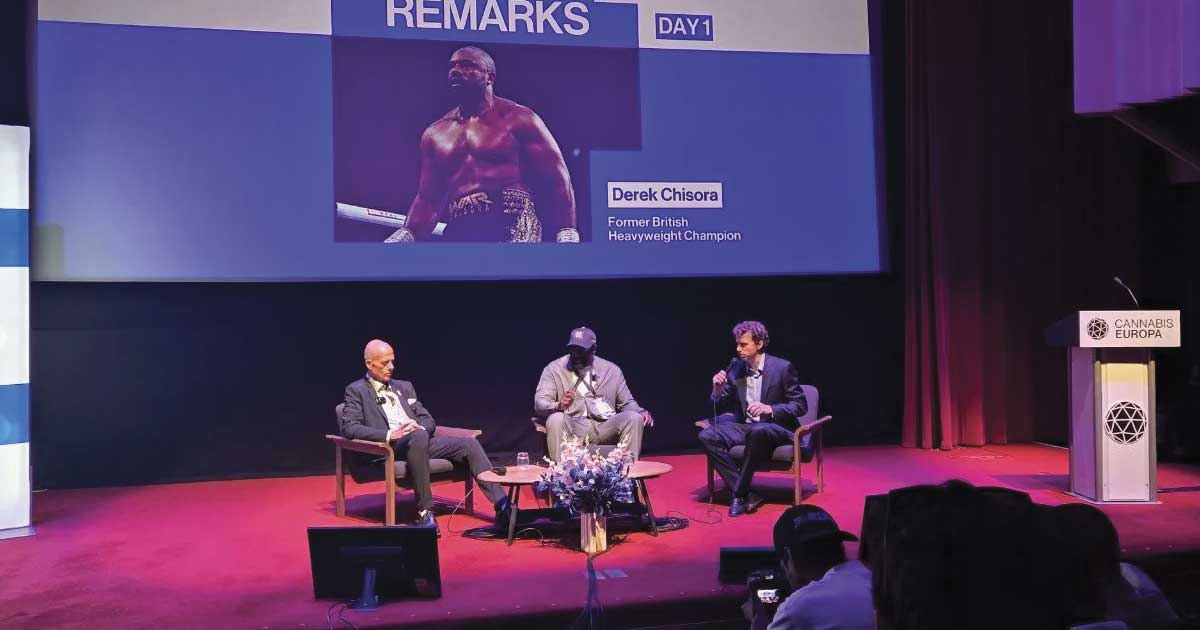
Opening session: Derek Chisora and Pierre Van Weperen
Former world heavyweight contender Derek Chisora joined Pierre Van Weperen, Managing Director of Grow Group Limited, to launch the patient‑education platform WarOnPain. Chisora disclosed that he uses medical cannabis on prescription, describing its role in sleep and recovery for elite athletes. Van Weperen noted the sector’s current advertising constraints—clinics cannot mention “cannabis” in promotions—and warned that the industry risks speaking only to an echo chamber. He argued that high‑profile athletes reach tens of millions of people, a demographic the cannabis sector has yet to engage effectively, especially given the eight‑million‑strong NHS waiting list for pain and mental‑health services.
Rebuilding cannabis as healthcare: where is European medical cannabis headed?
Panelists Yuval Soiref (Green Success) and Aras Azadian (Avicanna) examined how the U.S. rescheduling of cannabis to Schedule III is reshaping expectations in Europe. Azadian framed medical cannabis as a service requiring patient support, medical affairs, dosage guidance and clinical infrastructure, rather than merely a product. He stressed that reproducible, doctor‑prescribable outcomes depend on standardized cannabinoid‑based medicines—oils, sublinguals and oral formulations—rather than smoked flower. Soiref pointed to fragmentation as the sector’s chief structural obstacle and advocated for an AI‑driven, connected infrastructure that unifies patient acquisition, retention and operational data.
Policy in practice: from workplace testing to driving—what impact does UK legislation have on patients?
Richard List (Association of Police Controlled Drug Liaison Officers), Robert Jappie (Fieldfisher) and Sal Aziz (PatientsCann) addressed ongoing friction between patients and law‑enforcement eight years after the UK’s medical‑cannabis legalization. List acknowledged that many duty officers remain unaware of the law’s details, leading to stops, searches and arrests of patients who are legally possessing their medication. He described the current process: a patient stopped for suspected drug‑impaired driving must be taken to a station, undergo a blood test, and only then can invoke a medical defence. List’s association is revising the NPCC guidelines to incorporate roadside impairment checks, prescription verification and reserve blood sampling for suspected concomitant illicit use. Jappie urged the industry to protect its customers, arguing that one of legalization’s core promises—freedom from harassment by police, employers or landlords—remains unfulfilled.
Cannabis in international law: is gradual progress enough?
Featuring Kojo Koram (Centre for Transnational Research on Emerging Drug Markets), Carola Perez (We, The Patients), Steve Rolles (Transform Drug Policy Foundation) and Simone van Breda (Union of Coffeeshop Retailers), this session examined global inequities in cannabis access. Perez highlighted that patients in the Caribbean, South America and Asia are routinely excluded from policy conversations despite structural patient representation existing only in a consultative capacity. Koram traced the 1961 Single Convention’s origins to post‑war UN initiatives, noting that near‑universal adherence resulted from diplomatic pressure rather than organic consensus. He warned that corporate‑led reform without genuine activist and patient buy‑in risks backlash, potentially reversing hard‑won gains.
All eyes on Germany: the path to profitable growth and consolidation
The German market roundtable drew a full house, with Tristan Gervais (T Capital), Niklas Kouparanis (Bloomwell), David Henn (Cannamedical), Franziska Katterbach (Oppenhoff) and Benedikt Sons (Cansativa) discussing consolidation trends. Deutsche Bank’s entry into cannabis financing was described as a watershed, signalling willingness to fund operators with sales above €20 million. Katterbach characterised the current climate as a renaissance, noting major M&A activity and bank loans. Kouparanis outlined four consolidation archetypes: German‑to‑German deals, Canadian entrants, a second wave of U.S. multi‑state operators seeking a German foothold, and interest from pharma, tobacco and food conglomerates. Sons emphasized that profitability now outweighs raw revenue, with EBITDA multiples averaging six for conventional operators and reaching ten‑to‑fifteen for firms with proprietary technology platforms and patient‑service models.
For a full rundown of the day’s proceedings, see the original coverage Here.