

Cannabis Beverages Market: Size, Forecast and Outlook (2026‑2036)
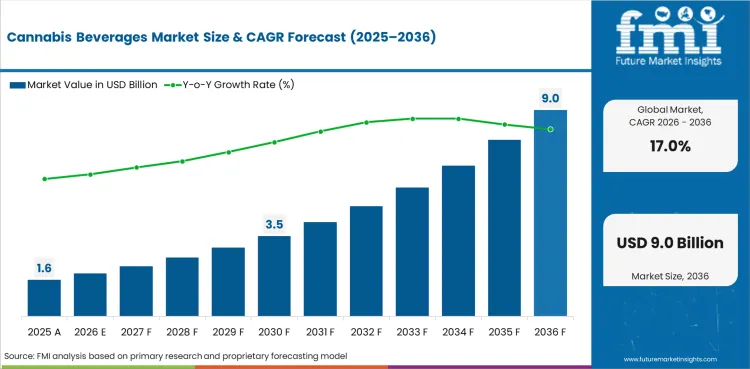
The cannabis beverages sector is poised for rapid expansion, with market value projected to climb from USD 1.87 billion in 2026 to USD 9.00 billion by 2036, representing a compound annual growth rate (CAGR) of 17.0 %. This growth translates into an incremental opportunity of roughly USD 7.13 billion over the forecast period. The upward trajectory is driven by a combination of legislative progress, shifting consumer preferences toward alcohol‑free alternatives, and strategic investments from established beverage and alcohol conglomerates.
Key Drivers Behind Market Expansion
Adult‑use legalization continues to broaden the licensed dispensary network, creating a reliable distribution backbone for infused drinks. In the United States, each newly‑legal state typically adds between 500 and 1,500 retail outlets, while Canada’s nationwide framework and pilot programs in Germany and Malta further reinforce access.
Concurrently, the sober‑curious movement is prompting consumers to replace traditional alcoholic beverages with low‑dose THC (2.5‑5 mg) or CBD‑infused options. This trend is especially pronounced among younger adults in North America and Western Europe, where declining alcohol consumption fuels demand for functional, socially acceptable alternatives.
Strategic partnerships between major alcohol companies and cannabis producers are accelerating scale‑up. Notable examples include Constellation Brands’ stake in Canopy Growth, Molson Coors’ joint venture with Hexo Corp, and Anheuser‑Busch InBev’s hemp‑beverage initiatives. These alliances bring brewing expertise, expansive distribution networks, and marketing firepower to the category.
Regulatory headwinds remain, particularly the federal Schedule I status of cannabis in the United States, which restricts interstate commerce, banking, and advertising. Nevertheless, vertically integrated operators with state‑level licences continue to capture the bulk of market activity.
Product and Component Landscape
Non‑alcoholic cannabis beverages are expected to dominate the product mix, holding a 54.2 % share in 2026. Their alignment with wellness trends, ease of dosing, and familiar formats (sparkling waters, teas, coffees) make them attractive to both new and experienced consumers.
On the ingredient side, cannabidiol (CBD) leads the component segment with a projected 63.5 % share in 2026. CBD’s regulatory acceptance in many jurisdictions, coupled with its positioning as a functional wellness ingredient, supports its prevalence across product lines. Tetrahydrocannabinol (THC) formulations, while subject to stricter limits, cater to recreational and micro‑dose use cases.
Distribution Channels and End‑Use Applications
Dispensaries remain the primary route to market, accounting for 42.6 % of distribution demand in 2026. Licensed cannabis stores provide the necessary compliance framework for THC‑containing products, while specialty retailers and wellness outlets facilitate CBD‑only offerings.
From an application perspective, wellness and health uses capture the largest share (38.4 %), driven by consumer interest in stress relief, sleep support, and mood enhancement. Recreational consumption, premium lifestyle positioning, and sports‑recovery segments also contribute meaningfully to overall demand.
Geographic Outlook
The Asia‑Pacific region is forecast to exhibit the fastest growth, propelled by rising consumer awareness, evolving regulatory frameworks, and expanding e‑commerce channels. Within this region, China and India stand out with projected CAGRs of 23.0 % and 21.4 % respectively, largely due to early‑stage adoption of CBD‑only products and increasing premium‑wellness retail.
In North America, the United States is anticipated to grow at a 14.5 % CAGR through 2036, supported by ongoing state‑level adult‑use legalization, dispensary network expansion, and continued investment from alcohol multinationals. Europe’s mature markets—Germany, the United Kingdom, and France—are expected to show steady growth, with Germany leading at 19.6 % CAGR, the UK at 16.2 %, and France at 17.9 %.
These regional dynamics reflect a two‑tier pattern: emerging markets gain share through new consumer uptake and distribution build‑out, while established markets evolve via product premiumization, format innovation, and brand differentiation.
Competitive Landscape and Strategic Positioning
A handful of integrated operators currently command a significant portion of global sales. Canopy Growth Corporation, The Cronos Group, Tilray Inc., and Aurora Cannabis Inc. are frequently cited as leaders due to their expansive production footprints, established buyer‑account relationships, and diversified product portfolios spanning commodity and premium tiers.
Mid‑tier players such as Hexo Corp. focus on regional and specialty formats, leveraging niche expertise to serve accounts that prioritize certified supply or localized production. Meanwhile, startups and small‑to‑medium enterprises are carving out positions in high‑margin, wellness‑oriented segments, often targeting subscription or direct‑to‑consumer channels.
Barriers to entry remain considerable, including the need for substantial manufacturing capital, compliance with safety and labeling standards, and the establishment of reliable supply contracts with procurement groups. Strategic responses involve expanding certified production capacity in high‑growth Asian markets, broadening distribution coverage, and launching premium formulations that match or exceed the performance of existing commodity offerings.
Methodology and Data Sources
Future Market Insights (FMI) derived the market size and forecast through a hybrid bottom‑up and top‑down approach. Primary research involved interviews with procurement leads, category managers, and product development heads across manufacturers, distributors, and key buyer accounts in North America, Europe, and Asia‑Pacific. Desk research incorporated industry association statistics, regulatory filings, corporate annual reports, and trade‑publication data to validate baseline figures.
Market sizing began with aggregated transaction volumes in the cannabis beverages segment, applying region‑specific growth rates and substitution curves to project demand through 2036. Quarterly updates cross‑check projections against customer survey data, manufacturer shipment disclosures, and regulatory filings to ensure ongoing accuracy.
Frequently Asked Questions
What is the expected market size for cannabis beverages in 2026?
Demand for cannabis beverages in the global market is estimated to be valued at USD 1.87 billion in 2026.
How large will the market be by 2036?
The market size for cannabis beverages is projected to reach USD 9.00 billion by 2036.
What is the forecasted growth rate between 2026 and 2036?
Demand for cannabis beverages is expected to grow at a CAGR of 17.0 % between 2026 and 2036.
Which product type is likely to lead sales in 2026?
Non‑Alcoholic Cannabis Beverages accounts for 54.2 % of the market in 2026, reflecting established buyer preference and functional performance advantages.
How do dispensaries influence adoption of cannabis beverages?
Dispensary channels represent 42.6 % of distribution demand, as operators and buyer accounts drive bulk procurement volumes through licensed retail networks.
What factors are driving growth in the United States?
The United States registers a 14.50 % CAGR through 2036, propelled by continued state‑level adult‑use legalization, rising dispensary‑network scale, and strategic investment from Constellation Brands and other alcohol multinationals.
How does FMI build and validate its forecast?
Forecasting models apply a hybrid bottom‑up methodology starting with verified transaction data, cross‑validated against industry sales statistics and manufacturer financial disclosures.
For additional details and to access the full report, please visit the source link: Here.