
President Trump’s Call to Protect Hemp‑Derived CBD Access
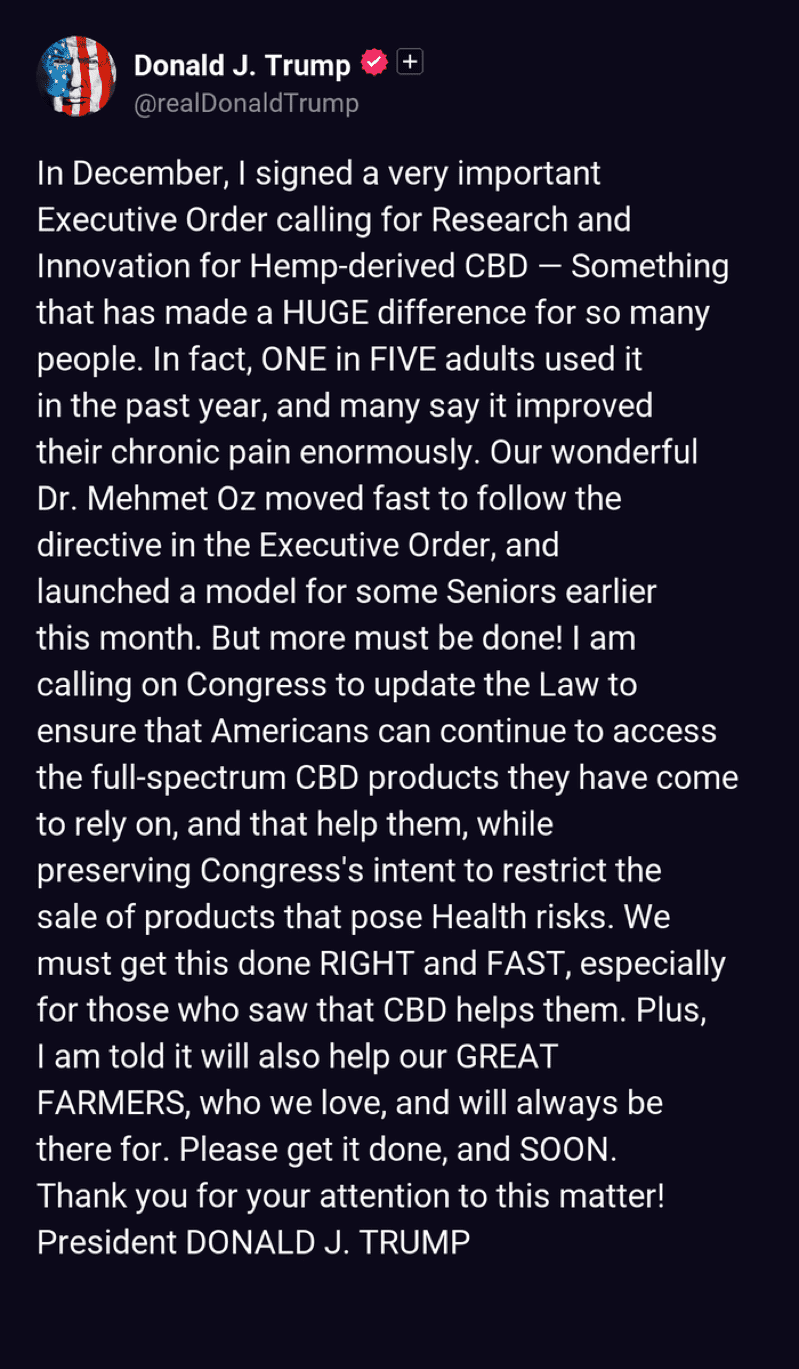
In a recent statement, former President Donald Trump highlighted what many consumers and agricultural stakeholders already recognize: hemp‑derived cannabidiol (CBD) products play a meaningful role in everyday wellness, support American farmers, and merit a sensible regulatory approach rather than an outright ban.
His remarks come at a critical juncture, with a federal prohibition on certain hemp products slated to take effect this November. Without timely congressional action, millions of Americans could lose access to legally produced, safety‑tested CBD goods, and thousands of hemp growers face economic uncertainty.
Why Hemp‑Derived CBD Matters to Consumers
Surveys indicate that over 60 % of U.S. adults have tried a CBD product at least once, citing benefits such as stress relief, improved sleep, and mild pain management (FDA, 2023). The market for hemp‑derived CBD is projected to surpass $20 billion by 2025, driven by demand for transparent, lab‑tested formulations (CBD Market Insights, 2023). Consumers increasingly seek products that are federally legal, free of harmful contaminants, and backed by clear labeling—criteria that a well‑crafted regulatory framework can enforce.
Economic Impact on American Farmers
The 2018 Farm Bill removed hemp from the Controlled Substances Act, opening the door for a revitalized agricultural sector. According to the USDA, hemp acreage grew from 0 in 2018 to more than 54,000 acres in 2022, generating roughly $1.2 billion in farm revenue (USDA, 2023). Small‑scale growers, many of whom operate family farms, rely on hemp as a rotational crop that improves soil health and diversifies income streams.
The Looming Federal Ban and the Need for Congressional Action
Despite the industry’s growth, a forthcoming federal rule threatens to classify certain hemp‑derived cannabinoids as Schedule I substances, effectively banning their sale. Stakeholders warn that such a move would:
- Eliminate legal access for millions of consumers who depend on CBD for wellness;
- Jeopardize the livelihoods of over 10,000 hemp farms nationwide;
- Push production into unregulated markets, increasing safety risks.
Lawmakers from both parties have expressed concern that a blanket prohibition ignores the distinction between non‑intoxicating hemp compounds and psychoactive THC. Experts urge Congress to pass legislation that:
- Establishes clear, science‑based thresholds for permissible cannabinoids;
- Requires third‑party testing and accurate product labeling;
- Provides a pathway for small businesses to comply without prohibitive costs.
Such measures would protect public health while preserving the economic benefits of a legal hemp market.
Industry Readiness to Collaborate on Solutions
Representatives from the Hemp Industries Association, the National Hemp Growers Coalition, and numerous CBD brands have signaled willingness to work with policymakers on a balanced framework. They emphasize:
- Existing good‑manufacturing‑practice (GMP) standards that already ensure product safety;
- Voluntary certification programs that could be adopted as baseline requirements;
- Commitment to ongoing research on cannabinoid efficacy and safety.
By engaging stakeholders early, Congress can craft rules that reflect real‑world industry practices rather than imposing one‑size‑fits‑all restrictions.
Conclusion
President Trump’s public acknowledgment underscores a bipartisan reality: hemp‑derived CBD products are valuable to consumers, vital to farmers, and deserving of thoughtful regulation. As the November deadline approaches, lawmakers have a narrow window to prevent unnecessary disruption and to build a regulatory structure that safeguards public health, supports rural economies, and maintains consumer choice.
For more details on the developments and how you can get involved, visit the Federal Action Center.