

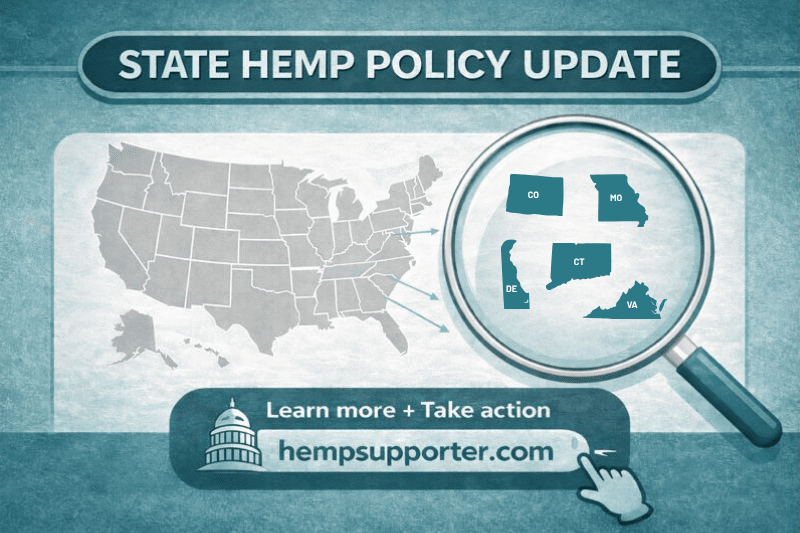
Take Action Now: Use our State Action Center to contact lawmakers and protect the future of hemp in your state
As legislatures nationwide review measures that could shape the hemp market, staying informed and engaged is essential. Below is a state‑by‑state snapshot of the bills we are tracking—highlighting where we support, oppose, or monitor legislation—and clear steps you can take to make your voice heard. Check back next week for updates, and feel free to share any additional bills you encounter that are not listed here.
Colorado
SB26-164 (Support)
Last week we noted that SB26-164 would create a transparent regulatory framework for hemp‑derived THC beverages in Colorado. The bill defines lawful THC beverages as non‑alcoholic hemp products containing up to 10 milligrams of THC per serving and establishes a regulated pathway for these items to be sold through traditional retail and hospitality channels.
This approach aligns with the model the US Hemp Roundtable (USHR) has advocated: sensible rules that protect consumers while allowing compliant businesses to thrive. If enacted, Colorado’s law could serve as a template for other states and demonstrate to Congress that regulation—not prohibition—is the preferable path forward.
Colorado Residents: Take Action: Contact your state lawmakers and urge them to support SB26-164.
Connecticut
H.B. 5350 (Monitoring)
We previously reported on H.B. 5350; last week the bill passed the House and now advances to the Senate. The legislation revises Connecticut’s cannabis, hemp, and infused‑beverage framework by expanding retail pathways for hemp drinks and raising allowable THC limits to 5 mg per container in package stores and 10 mg per container in dispensaries and other retailers.
The bill also introduces new standards for testing, labeling, manufacturing, and enforcement. While Connecticut appears to be pursuing a regulatory route rather than an outright ban, USHR is watching closely to ensure that lawful hemp businesses retain market access and that cannabinoid definitions remain precise enough to avoid unintentionally restricting compliant products.
No action is requested at this time. We will continue to monitor the bill’s progress.
Delaware
HB 373 (Oppose)
HB 373 has been introduced in Delaware and, if passed, would unnecessarily constrain market access and harm existing operators. The proposal permits beverages containing up to 10 mg of Delta‑9 THC per container and includes reasonable product‑testing, labeling, and youth‑access safeguards. However, it limits sales to package stores and marijuana retailers, imposes additional taxes and licensing fees, and adds operational burdens on businesses.
USHR supports sensible regulation of hemp beverages, but Delaware should avoid creating a system that needlessly restricts consumer choice and shuts out broader retail participation. Lawmakers are encouraged to pursue a more balanced framework that protects consumers without erecting unnecessary barriers for lawful enterprises.
Delaware Residents: Take Action: Reach out to your state legislators and urge them to vote NO on HB 373.
Missouri
HB 2641 (Oppose – Signed Into Law)
Governor Mike Kehoe has now signed HB 2641 into law. As we reported previously, the statute reclassifies hemp‑derived cannabinoid products as marijuana and confines manufacturing, distribution, and sales to Missouri’s existing marijuana license holders.
The law also imposes a 0.4 mg total THC limit per container, a threshold that would effectively eliminate most products currently sold in compliance with federal law. This new regulation is expected to profoundly disrupt Missouri’s hemp market, forcing many compliant businesses out of the industry while reducing consumer access to lawful hemp‑derived items.
USHR remains concerned that Missouri opted for market consolidation rather than reasonable regulation and will continue to watch for any amendments or improvements.
Virginia
SB 542 / HB 642 (Oppose – Urgent Veto Request)
SB 542 (previously discussed) and HB 642 have been returned to Governor Abigail Spanberger without incorporating her proposed amendments. Consequently, she must now decide whether to sign the bills in their current form or issue a veto.
Both measures pose a serious threat to Virginia’s hemp sector by imposing a 2 mg THC limit per package and establishing a state‑controlled retail cannabis market. If enacted, these bills would likely shut down numerous beneficial natural hemp wellness products currently available in the state and would markedly increase police presence in the cannabis space—a step backward for cannabis rights in Virginia that primarily advantages out‑of‑state corporate interests.
For these reasons, USHR is urging Governor Spanberger to veto SB 542 and HB 642 and to champion a free‑market approach for the emerging hemp and cannabis industry in Virginia.
Visit our State Action Center to see active campaigns across the country!
Check out the latest hemp and CBD updates from across the states!
- State Hemp Policy Update: Connecticut, Delaware, New Jersey
Take Action Now: Use our State Action Center to contact lawmakers and protect the future of hemp in your state. As state lawmakers across the country are considering legislation affecting hemp‑derived products. …
- State Hemp Policy Update: Colorado, Connecticut, Oklahoma, South Carolina
Take Action Now: Use our State Action Center to contact lawmakers and protect the future of hemp in your state. As state lawmakers across the country are considering legislation affecting hemp‑derived products. …
- Immediate Action Needed to Save the Hemp Industry in Oklahoma!
Oklahoma’s hemp industry is facing an existential threat and the US Hemp Roundtable is calling on you to take action and make your voice heard! SB 3, currently being reviewed to …
For more details on the bills mentioned above, see the original update Here.