

Legal Marijuana Market Size and Forecast 2026 to 2035
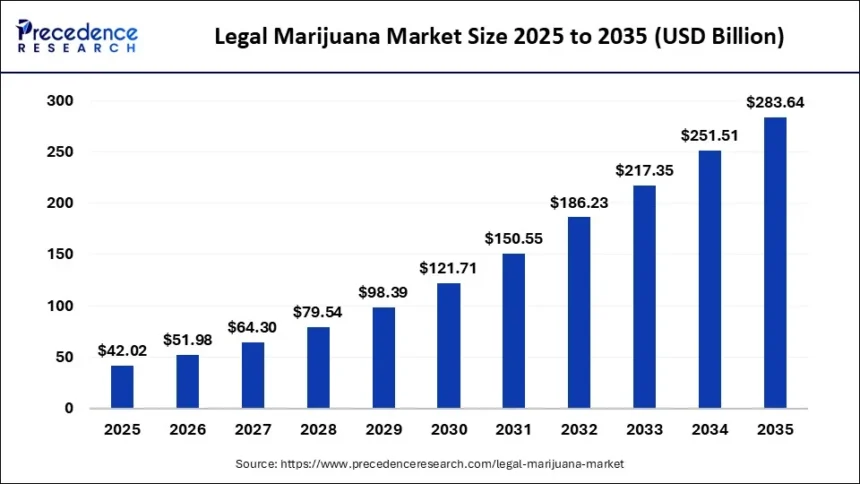
The global legal marijuana market reached USD 42.02 billion in 2025 and is projected to hit USD 51.98 billion in 2026, climbing to USD 283.64 billion by 2035, according to the latest market report. That trajectory reflects a compound annual growth rate of 21.04% from 2026 to 2035.
Legal Marijuana Market Key Takeaways
North America dominated the 2025 market, while Asia Pacific is expected to post the fastest CAGR through 2035. The medical segment captured 69% of sales in 2025, buds remained the leading product type, and oil is forecast to grow the quickest. Chronic pain accounted for the largest application share, and the mental‑disorder segment is set to expand the fastest.
Global Legal Marijuana Market Overview
Legal cannabis includes buds, resin, oil, tinctures, foods, drinks, capsules, topicals and other derivatives, and is used for pain relief, anxiety management, seizure control, insomnia and recreational purposes. Growing medical acceptance, research breakthroughs and supportive regulations drive market expansion.
AI‑Powered Transformation Reshaping the Legal Marijuana Market
Artificial intelligence monitors temperature, humidity, lighting and nutrient levels in real time, boosting yields while cutting grower costs. Retailers leverage AI‑driven recommendation engines to personalize product suggestions and anticipate consumer trends.
Legal Marijuana Market Trends
Cannabis‑infused beverages are gaining traction as consumers seek non‑smokable options. Medical marijuana prescriptions are rising worldwide, fueled by evidence of efficacy for chronic pain, epilepsy and other conditions. Premium, high‑potency products and sophisticated extraction methods are reshaping the supply chain, while heavy investment in research fuels new cannabinoid formulations and cultivation technologies.
Growth Drivers
Regulatory legalization for medical and recreational use expands the customer base. FDA‑approved synthetic cannabinoids such as dronabinol and nabilone legitimize therapeutic use. Skincare products infused with CBD show measurable anti‑aging results, spurring demand. The number of cultivators is increasing, generating significant government revenue and supporting diverse product development.
Regional Outlook
North America retains leadership thanks to mature retail networks, advanced cultivation technology and strong consumer awareness in the U.S. and Canada. Europe follows as the second‑largest market, with Germany leading due to high prescription rates and supportive health policies. Asia‑Pacific is poised for rapid growth, especially in Thailand and other emerging markets, despite overall conservative attitudes.
In Latin America, Brazil’s import surge—a 60% rise in March 2026—highlights growing demand for medicinal cannabis. The Middle East and Africa are moving slowly, with South Africa exploring personal‑use regulations and industrial hemp development.
Competitive Landscape
The market is semi‑consolidated, featuring large producers such as Canopy Growth, Tilray Brands, Aurora Cannabis, Curaleaf and Green Thumb Industries. Companies pursue growth through acquisitions, facility expansions, product launches and AI‑enabled operations. Strict licensing, high compliance costs and capital requirements remain barriers to entry.
Recent Developments (2025‑2026)
In March 2026 Virginia’s General Assembly passed a bill establishing a regulated recreational market slated for 2027. Canada continues to enforce stringent production standards after legalizing adult‑use cannabis nationwide. Thailand tightened its rules in 2025, shifting from a liberal stance to a medical‑only framework. These policy shifts underscore a maturing industry.
Conclusion
With a 21% CAGR and expanding applications across health, wellness and consumer goods, the legal cannabis market is on a rapid trajectory. Continued regulatory progress, AI integration and global expansion will drive further growth through 2035.