

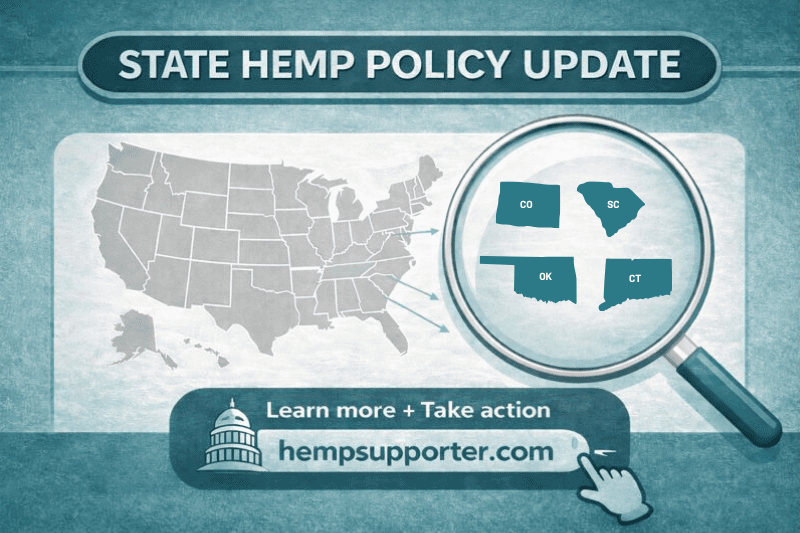
Colorado
Legislators in Colorado recently reviewed Senate Bill 26‑164, a proposal that would have created a clear regulatory path for hemp‑derived THC beverages. Under the bill, lawful THC beverages would be defined as non‑alcoholic hemp products containing up to 10 milligrams of THC per serving, allowing them to be sold alongside traditional retail and hospitality items.
Although the bill has stalled and is now considered dead for the current session, advocates note that the approach reflected a model the U.S. Hemp Roundtable has encouraged: sensible, science‑based rules that protect consumers while preserving market access for compliant businesses. Stakeholders continue to monitor any future attempts to revive similar legislation in Colorado.
Visit our State Action Center to see active campaigns across the country!
The State Action Center provides a simple way for residents to contact lawmakers, track pending bills, and support balanced hemp regulation. By entering your zip code, you can send a personalized message to your state representatives in just a few clicks.
Connecticut
Connecticut’s House Bill 5350 continues to advance through the legislature, having now cleared the second chamber. The measure seeks to reshape the state’s cannabis and hemp framework by redefining “cannabis” to include high‑THC hemp products while explicitly exempting compliant hemp (≤ 0.3 % total THC), infused beverages, and certain commercial extracts.
If enacted, the bill would raise the permissible THC limit for infused beverages to 5 mg per container in liquor‑licensed venues and 10 mg per container at cannabis retailers. It would also create a distinct category for high‑THC beverages, restrict those products to out‑of‑state sales, and establish a comprehensive regulatory structure covering licensing, testing, labeling, distribution, age verification, fees, and on‑premises consumption endorsements.
At this stage, the U.S. Hemp Roundtable is monitoring the bill’s progress and has not issued a call to action. Stakeholders are encouraged to stay informed as the legislation moves toward a potential vote.
Check out the latest hemp and CBD updates from across the states!
Our latest posts highlight recent developments in state hemp policy, offering concise summaries and direct links to full reports. These updates help advocates and industry professionals stay ahead of legislative changes.
Oklahoma
Oklahoma’s hemp sector is confronting a significant challenge with Senate Bill 3, which proposes a federal‑style total THC limit based on a 0.4 mg per‑container standard. Analysis indicates that such a threshold would effectively remove approximately 95 % of currently compliant hemp products from the market, jeopardizing thousands of jobs, numerous small businesses, and the livelihoods of Oklahoma farmers and retailers.
The U.S. Hemp Roundtable acknowledges the need for strong, science‑based regulation but contends that S.B. 3 exceeds what is necessary to protect public health. Instead, the organization supports alternatives like H.B. 4248, which aim to balance safety with market viability.
Oklahoma Residents: Take Action — Contact your State Senators and urge Senate leadership not to advance S.B. 3 further. Key decision‑makers on this bill include Senators Paxton, Coleman, and Green; your voice can help shape a more balanced outcome for the state’s hemp industry.
South Carolina
South Carolina is nearing a critical juncture in its hemp legislation. Lawmakers are actively negotiating in a conference committee, with the possibility of final agreement within days. Once a compromise is reached, the bill will move swiftly to final passage, leaving limited opportunity for amendments.
Current discussions include proposals that could restrict allowable product categories, limit where hemp‑derived items may be sold, and impose new licensing and operational requirements on existing businesses. Some versions under consideration would effectively eliminate large portions of the current marketplace—including many wellness‑focused products—and shift remaining sales into tightly controlled channels.
Such frameworks risk forcing current hemp retailers to overhaul their business models, incur substantial compliance costs, or cease operations altogether. They could also reduce consumer access to tested, regulated products and eliminate common retail pathways such as direct‑to‑consumer sales.
South Carolina has the opportunity to adopt thoughtful, science‑based regulation that safeguards consumers without dismantling the existing marketplace. With time running short, advocates urge residents to act now.
South Carolina Residents – Take Action: Reach out to your state lawmakers immediately and encourage them to oppose overly restrictive hemp legislation. Instead, support a balanced, workable regulatory framework that preserves consumer access, protects public health, and sustains local businesses.
For more details on the latest state‑by‑state hemp policy developments, see the full update Here.