
Take Action Now: Use our State Action Center to contact lawmakers and protect the future of hemp in your state.
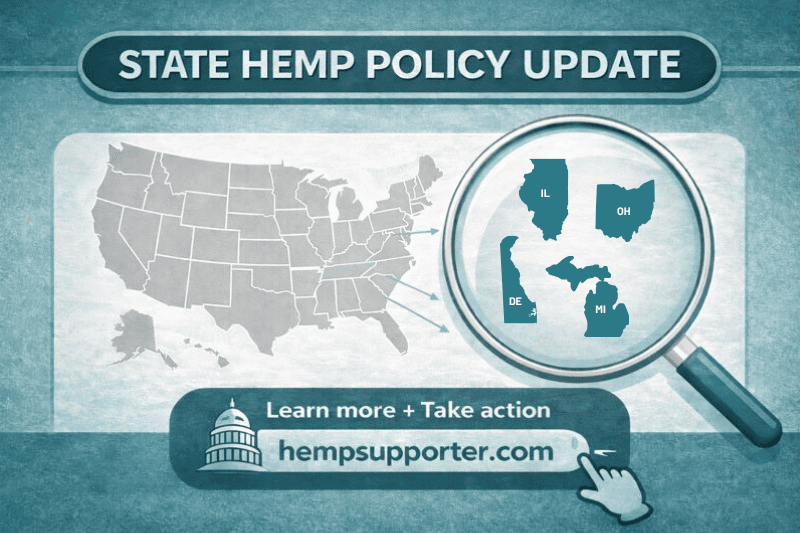
State legislatures are actively reviewing measures that could shape the hemp‑derived marketplace. The following state‑by‑state overview highlights bills we are tracking, supporting, or opposing, and notes where public input can make a difference. Check back next week for updates, and feel free to share any pending legislation you encounter that isn’t covered here.
Delaware
HB 373 / HB 395 (Oppose)
We have been following these proposals closely, and Delaware advocates need to act immediately. Both bills appear on the Delaware House agenda for Tuesday, June 16, meaning a vote could occur as early as today.
HB 373 would impose unnecessary limits on market access and disadvantage existing operators. It creates a new regulatory scheme for THC‑infused beverages, covering manufacturing standards, licensing, taxation, and where the drinks may be sold.
Although the bill permits up to 10 mg of delta‑9 THC per container and includes sensible testing, labeling, and youth‑protection provisions, it restricts sales to package stores and marijuana retailers while adding new taxes, fees, and operational requirements. Delaware should avoid a framework that unnecessarily curtails consumer choice and excludes broader retail participation.
HB 395 seeks to treat many hemp‑derived cannabinoid products as marijuana by applying a 0.4 mg total THC per container threshold.
The legislation also delineates which cannabinoids are considered non‑intoxicating and introduces the notion of “counterfeit THC ingredients”—cannabinoids not naturally produced by the cannabis plant or those created synthetically—barring their use in products meant for humans or animals. If enacted, this bill would eliminate more than 95 % of the current hemp marketplace in Delaware.
Delaware Residents: Take Action: Contact your state legislators and urge them to vote NO on HB 373 and HB 395.
*The Delaware legislative session is presently set to adjourn on June 30, 2026.*
Illinois
HB 5784 / SB 20 (Oppose)
In recent developments, Illinois lawmakers passed HB 5784 in the House and SB 20 in the Senate, both of which would substantially constrain the state’s hemp sector.
Each bill enforces a strict limit of 0.4 mg of total THC (and other cannabinoids with comparable effects) per container, effectively prohibiting roughly 95 % of hemp‑derived items currently on the market. Products exceeding that cap would no longer qualify as lawful hemp and could only be sold through licensed cannabis dispensaries.
The proposals also remove many existing hemp‑derived cannabinoid products from the legal definition of hemp, impose extensive registration and compliance obligations on retailers and manufacturers, and grant sweeping enforcement authority over the marketplace.
*The Illinois General Assembly convenes year‑round, with the next regular session not scheduled until the veto period in November/December 2026. At present there is no specific call to action, but we will provide further updates as they become available.*
Michigan
HB 5040 / HB 5041 / HB 5042 / HB 5043 (Monitoring)
Michigan stakeholders anticipate a hearing before the House Regulatory Reform Committee this week on a package of hemp‑related bills.
Most notably, HB 5040 would define “nonintoxicating cannabinoids” to include full‑spectrum industrial hemp extract only when it contains no more than 1.75 mg of THC per serving and maintains a CBD‑to‑THC ratio of at least 15:1. Products surpassing that threshold would fall outside the nonintoxicating classification, raising serious concerns for a wide array of CBD offerings currently available—effectively banning most hemp beverages.
HB 5040 would also establish a new regulatory regime for “consumable hemp products,” introducing licensing mandates for processors, product sampling and testing, labeling requirements, fees, rulemaking authority, and civil sanctions. Its labeling provisions would call for bold‑capital warning statements, ingredient lists, net weight, and disclosure of the percentage of nonintoxicating cannabinoids by weight.
The bill further categorizes a broad spectrum of cannabinoids as “intoxicating,” including delta‑9, delta‑8, delta‑7, delta‑10, certain THC metabolites, hydrogenated THC forms, synthetic THC, esterified THC, and any cannabinoids designated by rule. It also creates a distinct category for “potentially intoxicating cannabinoids.”
The accompanying clean‑up bills would make conforming changes if HB 5040 is enacted. HB 5041 would amend the Medical Marihuana Facilities Licensing Act, stripping cross‑references to industrial hemp under that statute. HB 5042 would revise the Industrial Hemp Growers Act while preserving the 0.3 % total delta‑9 THC limit and adjusting sampling, testing, transport, and registration rules. HB 5043 would update the Michigan Regulation and Taxation of Marihuana Act, likewise retaining the 0.3 % total delta‑9 THC threshold. All three measures are tie‑barred to HB 5040.
No action requested at this time. We will continue to monitor developments and issue an action alert when more information is available.
*The Michigan legislature meets intermittently throughout the year.*
Ohio
SB 56 / Federal Judge Issues Temporary Restraining Order on Enforcement of SB 56
We have been tracking the situation in Ohio surrounding SB 56, and we are pleased to report a recent development: a federal judge issued a temporary restraining order on June 15, 2026 that blocks enforcement of Ohio’s new hemp restrictions in SB 56 against the plaintiff companies in a federal lawsuit challenging the law. The order, rendered by Judge Jeffrey J. Helmick of the U.S. District Court for the Northern District of Ohio, lasts 14 days and prohibits criminal, civil, administrative, or regulatory enforcement actions against those plaintiffs while the case proceeds.
In his order, Judge Helmick noted that the plaintiffs are likely to succeed on the merits of their claim that SB 56 violates the dormant Commerce Clause because, although Ohio contends the law is facially neutral, businesses seeking to sell the covered hemp‑derived products must obtain, transfer, and dispense those items exclusively from locations within Ohio. The lawsuit was filed by ten companies that manufacture and sell hemp beverages and other hemp‑derived products. SB 56 was signed into law in December 2025 and took effect on March 20, 2026.
No action requested at this time. We are monitoring this litigation closely and will share updates as further information emerges.
*The Ohio legislature convenes periodically throughout the year.*
Visit our State Action Center to see active campaigns across the country!
Check out the latest hemp and CBD updates from across the states!
- State Hemp Policy Update: Delaware, Illinois, Michigan, and Ohio.
Take Action Now: Use our State Action Center to contact lawmakers and protect the future of hemp in your state. As state lawmakers across the country are considering legislation affecting hemp‑derived products. …
- State Hemp Policy Update: Delaware, Illinois, Nebraska, New Jersey, Pennsylvania (Philadelphia), and Virginia
Take Action Now: Use our State Action Center to contact lawmakers and protect the future of hemp in your state. We’re officially back with our state updates. for 2026. As state lawmakers …
- State Hemp Policy Update: Connecticut, Delaware, New Jersey
Take Action Now: Use our State Action Center to contact lawmakers and protect the future of hemp in your state. As state lawmakers across the country are considering legislation affecting hemp‑derived products. …