
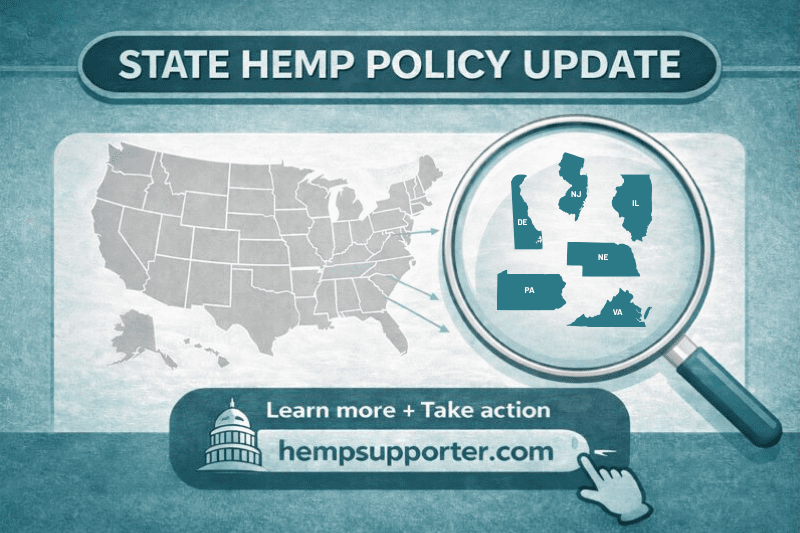
Delaware – HB 395 Under Review
The Delaware House Bill 395 seeks to reshape the state’s hemp framework by imposing a “total THC” threshold that would effectively treat many hemp‑derived cannabinoid products as marijuana. Under the proposal, any container holding more than 0.4 mg of total THC would be classified as a marijuana product, a limit that would remove an estimated 95 % of current hemp items from the market. The bill also sets a 0.3 % total THC cap for industrial hemp and introduces the concept of “counterfeit THC ingredients,” which are cannabinoids not naturally produced by the cannabis plant or synthetically altered versions. Products containing these substances for human or animal consumption would be prohibited.
Supporters of the measure argue it closes loopholes that allow intoxicating hemp products to evade marijuana regulations. Critics, including the U.S. Hemp Roundtable, contend that the 0.4 mg per‑container limit is arbitrary and not grounded in scientific evidence of impairment. They note that the 2018 Farm Bill defines lawful hemp as containing no more than 0.3 % delta‑9 THC on a dry‑weight basis, a standard that has allowed a diverse marketplace of low‑dose hemp supplements to flourish nationwide.
What Delaware residents can do: Contact your state legislators and urge them to oppose HB 395. Emphasize the need for regulations that protect public safety without eliminating federally lawful hemp products that support local farmers, retailers, and consumers.
Illinois – HB 5784 and SB 20 Pose Market Threats
Illinois lawmakers have introduced companion bills—HB 5784 in the House and SB 20 in the Senate—that would impose a strict 0.4 mg per‑container cap on total THC and cannabinoids with similar effects. Products exceeding this limit would no longer qualify as lawful hemp and would be forced into the state’s licensed cannabis dispensary system. The legislation also proposes extensive registration and compliance requirements for retailers and manufacturers, and it would exclude many existing hemp‑derived cannabinoid items from the legal definition of hemp.
Industry analysts estimate that the 0.4 mg threshold would remove roughly 95 % of current hemp offerings from retail shelves, dramatically shrinking consumer choice and impacting small businesses that rely on low‑dose products such as tinctures, edibles, and topicals. The U.S. Hemp Roundtable highlights that the proposed limit deviates from the Farm Bill’s 0.3 % THC standard and lacks empirical justification for impairment at such low concentrations.
How Illinois residents can respond: Reach out to your representatives and senators to oppose HB 5784 and SB 20. Advocate for a balanced regulatory approach that includes age restrictions, product testing, and clear labeling while preserving access to federally compliant hemp goods.
Nebraska – Monitoring Proposed Adulterated Food Product Regulations
The Nebraska Department of Agriculture has issued a Notice of Rulemaking Hearing concerning proposed “Adulterated Food Product Regulations” under the Nebraska Pure Food Act. The draft rules would define food products containing or labeled to contain tetrahydrocannabinols as potentially adulterated or misbranded. Specific attention is given to items such as gummies, drops, and beverages that market synthetic THC compounds intended to mimic the psychoactive effects of delta‑9 THC.
A public hearing is scheduled for June 18, 2026, at 10:00 a.m. CT in the LL Hearing Room, 245 Fallbrook Blvd, Lincoln, NE. Written comments may be submitted to the Department of Agriculture by June 17, 2026, via mail to PO Box 94947, 245 Fallbrook Blvd Ste 200, Lincoln, NE 68521, or by email to [email protected]. At this stage, no action is requested; stakeholders are encouraged to review the proposal and submit feedback as the rulemaking process unfolds.
New Jersey – A5051 / S4297 Seeks to Adjust Existing Framework
New Jersey maintains one of the more restrictive hemp regimes in the nation. Current law caps total THC at 0.4 mg per container for many hemp‑derived cannabinoid products and permits intoxicating hemp beverages to be sold through licensed alcohol and cannabis outlets until November 13, 2026, subject to serving‑size, testing, labeling, and retail restrictions.
Assembly Bill A5051, which has already passed the House, and its Senate counterpart, S4297, aim to amend rather than replace the existing structure. Key provisions include:
- Extending implementation deadlines for hemp processing and intoxicating hemp beverages from May 31, 2026, to November 13, 2026.
- Allowing cans with up to 5 mg of THC per serving (10 mg per container) and resealable 750 mL bottles containing up to 40 servings of 5 mg each (200 mg total THC per bottle).
- Removing the requirement that intoxicating hemp beverages be stored behind counters.
- Permitting licensed alcohol establishments to display these beverages in customer‑accessible areas when monitoring, signage, and age‑verification measures are in place.
- Requiring retailers to inform purchasers of appropriate serving sizes.
- Allowing a 10 % variance in laboratory testing results for cannabinoid concentrations.
- Expanding the ability of certain alcohol license holders to sell intoxicating hemp beverages for off‑premises consumption.
The bills preserve New Jersey’s existing THC limits for non‑beverage hemp products, meaning many low‑dose supplements would remain subject to the 0.4 mg per‑container rule. Advocates urge lawmakers to support the beverage‑friendly amendments while simultaneously pushing for a science‑based, statewide standard that accommodates a broader array of hemp‑derived products without resorting to overly restrictive thresholds.
What New Jersey residents can do: Contact your state legislators to voice support for A5051/S4297’s reasonable improvements to the hemp beverage framework, and request that they pursue broader, evidence‑based regulations for all hemp‑derived cannabinoid products.
Pennsylvania (Philadelphia) – City Ordinance Bill No. 260163
Philadelphia City Council is reviewing Bill No. 260163, an ordinance that would create a new regulatory regime for “intoxicating substances,” encompassing hemp‑derived cannabinoid products and kratom. The most contentious provision mirrors federal discussions: a prohibition on the sale of final hemp‑derived cannabinoid products containing more than 0.4 mg of total tetrahydrocannabinols per container. Analysts estimate this limit would eliminate roughly 95 % of current hemp offerings from Philadelphia storefronts.
Additional measures in the ordinance include:
- Banning cannabinoids that are not naturally produced by the cannabis plant or are synthetically manufactured.
- Prohibiting direct‑to‑consumer sales of intermediate hemp‑derived cannabinoid products.
- Restricting sales of intoxicating substances to individuals aged 21 and older.
- Requiring each retail location to obtain an “Intoxicating Substance Retailer” license.
- Imposing zoning and location restrictions on retailers.
- Mandating testing for THC concentration, contaminants, heavy metals, pesticides, solvents, mycotoxins, and microbial impurities.
- Establishing labeling requirements and civil penalties for violations.
While the ordinance is presented as a public‑safety initiative, critics argue that the 0.4 mg per‑container cap is arbitrary and would undermine access to federally lawful hemp products that support local businesses and consumer wellness. The U.S. Hemp Roundtable recommends that council members focus on evidence‑based safeguards—such as robust age verification, product testing, clear labeling, and enforcement against bad actors—rather than adopting thresholds that lack a scientific basis for impairment.
How Philadelphia residents can act: Reach out to your City Council members and urge opposition to Bill No. 260163. Advocate for regulations that protect youth and public safety while preserving the legal hemp marketplace that contributes to the city’s economy.
Virginia – Monitoring HB 2485 After Marijuana Veto
Governor Abigail Spanberger recently vetoed SB 542/HB 642, legislation that would have created a regulated adult‑use marijuana market in Virginia. Although the veto primarily concerned marijuana policy, the decision has implications for hemp because the proposed marijuana framework included provisions that could have affected intoxicating hemp products, retail structures, and future cannabinoid regulation discussions.
Governor Spanberger cited public‑safety concerns, impaired driving risks, youth access, and implementation challenges as reasons for the veto. At present, no direct alterations to Virginia’s existing hemp rules have resulted from the veto, but stakeholders anticipate continued deliberations on how to balance a potential adult‑use cannabis market with the preservation of federally compliant hemp products.
Jonathan Miller, General Counsel of the U.S. Hemp Roundtable, praised the veto for protecting access to lawful hemp supplements while acknowledging the tension between supporting marijuana legalization and defending the hemp industry. He expressed hope that future legislative sessions could craft a regulated cannabis market that does not impede low‑dose hemp products meeting federal standards, such as those referenced by the Centers for Medicare and Medicaid Services for oral, non‑inhalable hemp supplements.
What Virginians can do: Stay informed about upcoming hemp‑related bills, engage with local lawmakers, and advocate for policies that protect consumer access to safe, low‑dose hemp products while addressing any legitimate public‑safety concerns.
Take Action Now
Visit our State Action Center to find contact information for your legislators, submit comments on pending rules, and stay updated on evolving hemp policy across the country.