

The New Toolkit
Four cutting‑edge tools—commercial F1 hybrid seed, triploid seed, genomics testing and gene editing—are now standard in cannabis breeding, promising more predictable crops, faster cycles and reduced space needs. A 2026 study shows triploid seed cuts filled‑seed production by 98.5% in the field and 99.5% in greenhouse trials, while functional homozygosity in parent lines is defined as under 3% residual heterozygosity on a 1,500‑SNP panel. [4][5]
These technologies can concentrate control, shrink genetic diversity and create new business models, but they also shift power toward entities that own the underlying libraries and infrastructure.
Who Controls the Genetic Library?
The industry now splits into two overlapping tracks: well‑financed corporate labs and licensed producers on one side, and independent breeders, seed savers and small growers on the other, with service laboratories, universities and public researchers occupying the middle ground. Access to the shared genetic toolkit varies widely, making ownership of the library a strategic battleground. [1][2]
Regulatory Landscape
USDA APHIS has declared three gene‑edited hemp lines from the Wisconsin Crop Innovation Center—Badger G, Badger PMR and Badger Zero—as not regulated under 7 CFR part 340, a decision based on developer submissions and not a product approval. [16][17][24] In the European Union, gene‑edited plants remain regulated as GMOs, though Regulation (EU) 2026/1388 will exempt simple edits (category 1) from GMO rules starting July 2028, while more complex edits stay under existing GMO frameworks. [28]
Clean‑Stock Practices Remain Critical
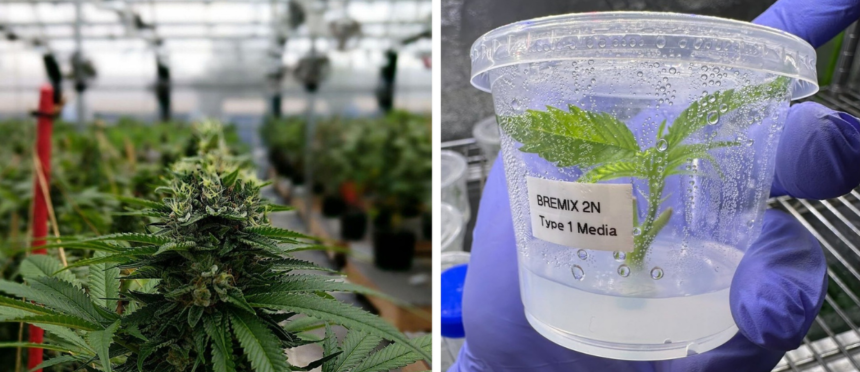
Hop Latent Viroid (HLVd) has no deployed genetic resistance; the only proven defense is an integrated clean‑stock system that tests, isolates, sanitizes, recovers and retests material. Meristem‑tip therapy can rescue elite cultivars but is genotype‑dependent and requires repeated molecular verification. [13][14]
F1 Hybrids: What the Label Really Means
“F1” simply denotes the first filial generation from a defined cross; it does not guarantee uniformity, vigor or yield. True commercial F1 hybrids require documented parent lines that are functionally homozygous—less than 3% residual heterozygosity on a high‑density SNP panel—and must be verified through replicated grow‑out data, not photographs. [4]
Future Outlook
Gene‑editing progress hinges on reliable regeneration across diverse genotypes; until tissue‑culture bottlenecks are solved, editing speed may outpace breeding capacity. Genomic selection is only as strong as the breeding population and field validation behind it, and preserving landrace diversity remains essential for long‑term innovation. [6][10]
Growers are now custodians of a living genetic library, using precise tools while demanding transparent evidence, maintaining clean parent stock and safeguarding diversity for future improvement.