

Virginia Sets July 2027 Launch for Legal Retail Cannabis Market
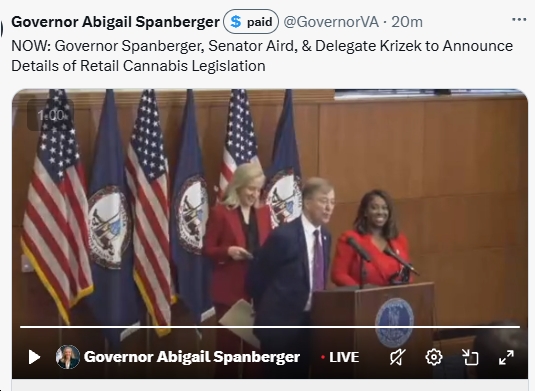
RICHMOND, Va. — State officials announced a budget compromise that will allow Virginia’s legal retail cannabis market to open on July 1, 2027. The agreement was reached by Gov. Abigail Spanberger, Sen. Lashrecse Aird, and Del. Paul Krizek after months of negotiations.
The deal follows Spanberger’s veto of earlier legislation this year, when lawmakers rejected her call for a later start date and stricter penalties. By folding cannabis provisions into the state’s spending plan, legislators avoid a potential government shutdown that would occur if the budget is not passed by June 30.
“I am excited to stand alongside Senator Lashrecse Aird and Delegate Paul Krizek to announce that we have agreed to a proposal that will create a safe, legal, and well‑regulated cannabis market here in the Commonwealth,” Spanberger said during a press conference at the Patrick Henry Building.
Gov. Abigail Spanberger announces Virginia retail marijuana compromise
She explained that the plan aims to protect consumers, undercut the illicit market through clear enforcement and regulatory authority, encourage competition for small businesses and farmers, and put safeguards in place to prevent sales and advertising to minors.
Aird described the outcome as a demonstration of flexibility and shared priorities, noting that the compromise is designed to “protect young people, give Virginians a safe legal option, and avoid criminalizing adult use.”
Background and Negotiations
The agreement emerged after a series of meetings in which lawmakers balanced public‑health concerns with economic opportunities. Spanberger’s original proposal had called for a more limited number of stores and a different tax structure, but negotiators settled on a middle path they say addresses both oversaturation worries and the need to steer buyers away from illegal sources.
Key details of the compromise
- Retail launch date: July 1, 2027
- State cannabis tax: 6% at launch, rising to 8% after July 1, 2029. Localities may add a tax of 1% to 3.5%. This would be added to the existing state sales tax, which varies by region, but has a base of 5.3%. This would mean the initial tax rate would be between 12.3% and 14.8%.
- Licensing: Cap of 350 retail licenses statewide, but licenses will be phased in based on demand and geographic balance as determined by the Cannabis Control Authority (CCA).
- Public consumption penalty: $250 civil fine, delayed until July 2027 to allow time to assess potential disproportionate enforcement impacts.
- Product safety: Strict testing, labeling, and regulation of intoxicating hemp products sold outside licensed cannabis stores.
- 75% of first-year license fee revenue will go to the Cannabis Equity Business Loan Fund to help entrepreneurs in communities harmed by prior cannabis laws.
- Full criteria for impact licensees remain unchanged, but lawmakers will finalize specific fund allocation rules in next year’s session.
- Up to 100 microbusiness licenses may be issued by May 1, 2027, with each allowed to operate up to two locations.
- A five-year holding period for impact licenses to prevent predatory takeovers.
- Creation of a Cannabis Impact Business Support Team offering technical assistance to small and equity-owned businesses.
“If our goal is to move consumers away from the illicit market, then the legal market has to be able to compete,” Aird said, calling the phased-in tax rate a “public safety strategy” as well as an economic decision.
Sen. Lashrecse Aird announces Virginia retail marijuana compromise
Spanberger said tiered tax rates drew on models from other states to encourage early conversion from the illicit market.
The compromise on licensing, increasing her initial 200‑store cap to 350 but spacing their rollout, came from concerns about oversaturation.
“In the end, I’m actually happier with this as a solution than what I had suggested,” she said.
The agreement drops controversial “transport penalties” that some critics likened to second‑degree homicide charges. Enforcement will focus on preventing harm to young people — especially illegal sales to minors — rather than imposing extreme penalties for transporting cannabis.
Krizek emphasized equity and small business access.
Del. Paul Krizek announces Virginia retail marijuana compromise
The plan directs 75% of first-year license fee revenue into the Cannabis Equity Business Loan Fund to help entrepreneurs overcome capital barriers and permits issuance of up to 100 micro business licenses by May 1, 2027, allowing each to operate two locations.
“As we move into a legal marketplace, we have an obligation to make sure opportunity is not limited only to those who already have access to capital and political connections,” Krizek said. “A license alone does not create a successful small business.”
The compromise also includes protections against predatory investment structures, with a five‑year holding period for impact licenses, limits on ownership transfers, and the creation of a Cannabis Impact Business Support Team to guide entrepreneurs through regulations. It preserves seed‑to‑sale tracking, strict product testing protocols, and mandatory reporting requirements.
“This is a serious, workable framework that moves Virginia forward,”Krizek said. “It protects consumers, supports legitimate businesses, gives localities clear rules, and provides meaningful enforcement tools.”
Virginia leaders answer questions about retail marijuana compromise
Budget conferees say the broader spending plan is nearing completion ahead of the end‑of‑month deadline.
Officials framed the cannabis deal as a “strong foundation” that the Joint Commission will keep reviewing after launch.
This is a developing story. Email the CBS 6 Newsroom if you have additional information to share.
📲: CONNECT WITH US
Blue Sky | Facebook | Instagram | X | Threads | TikTok | YouTube
This story was initially reported by a journalist and has been converted to this platform with the assistance of AI. Our editorial team verifies all reporting on all platforms for fairness and accuracy. To learn more about how we use AI in our newsroom, click here.