
Alcohol Industry Group Warns Congress Missed Chance to Regulate Hemp THC Products
A major alcohol industry trade association says the U.S. House of Representatives’ passage last week of a Farm Bill without including provisions to call off the federal recriminalization of hemp THC products represents a “missed opportunity.”
“A ban will not remove these products from the market—it will push consumers toward unregulated, online channels with no age verification, no product standards and no accountability,” said Dawson Hobbs, executive vice president of government affairs for Wine & Spirits Wholesalers of America (WSWA), in a press release on Monday.
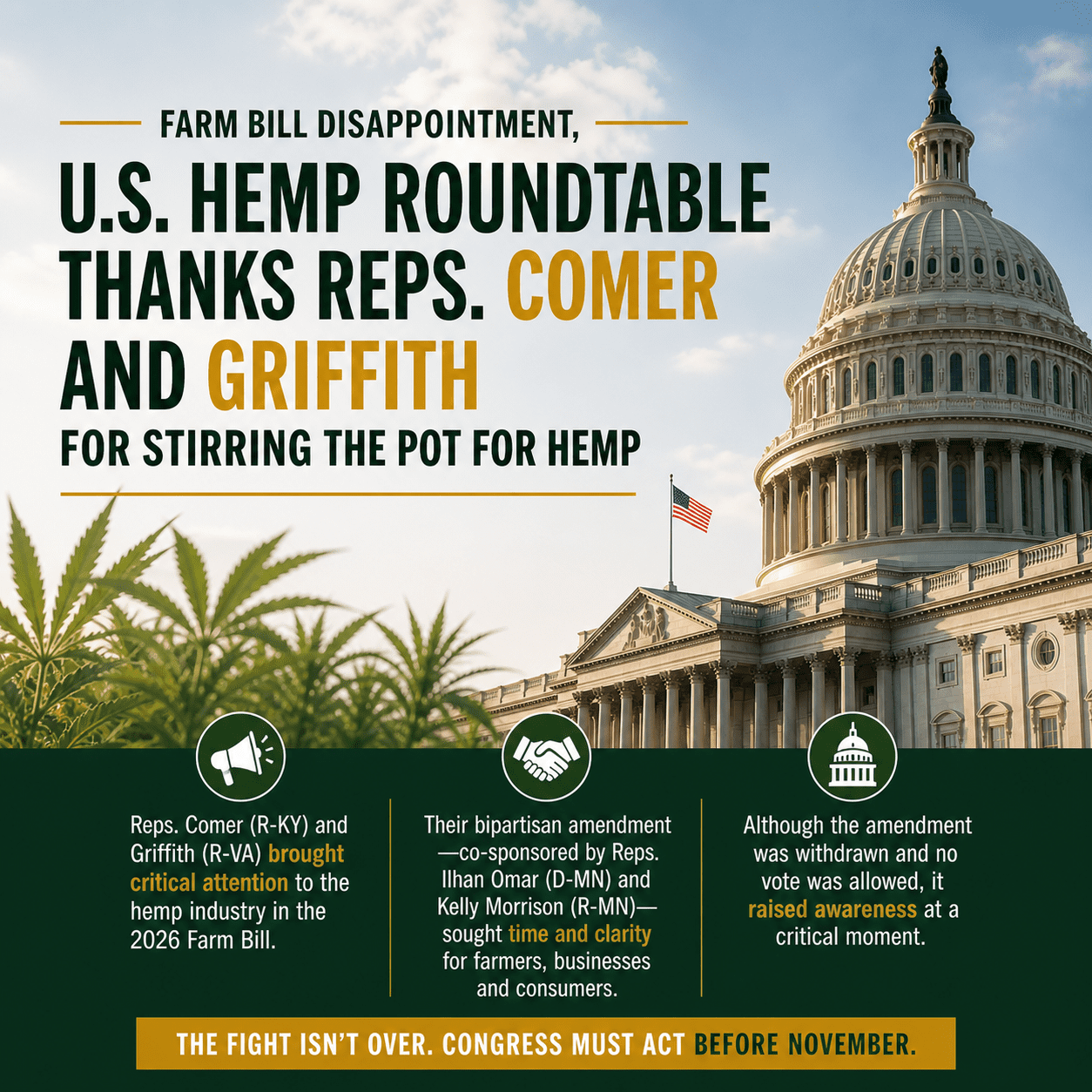
The House voted 224‑200 to pass H.R.7567, the Farm, Food, and National Security Act of 2026. While the legislation does contain some provisions aimed at reducing regulatory burdens for producers of industrial hemp, it does not include any language to alter or delay the impending ban on hemp THC products.
WSWA Calls for a Federal Framework Similar to Alcohol Regulation
WSWA has long argued that intoxicating beverages should be subject to baseline federal regulations that allow for additional state‑specific solutions. Hobbs pointed out that the alcohol industry’s 90‑year track record shows responsible regulation works.
“The 2026 Farm Bill’s failure to address the November ban on intoxicating hemp products is a missed opportunity,” Hobbs said. “We urge the Senate to act before November 2026 to replace this ban with a durable federal framework that actually protects consumers.”
WSWA’s educational microsite advocates applying the same regulatory system that has worked for alcohol to intoxicating hemp products. The group proposes federal licensure of suppliers and distributors, a federal tax, independent testing requirements, and regulation of trade practices—such as a prohibition on slotting fees—while allowing states to oversee the products in their own markets.
Legislative Efforts and White House Engagement
Bipartisan lawmakers had filed amendments to the bill to regulate hemp THC products and delay the ban, but the sponsors withdrew those proposals for undisclosed reasons. A separate amendment to speed up recriminalization was also filed, yet the House Rules Committee did not allow it to advance to floor consideration.
Meanwhile, White House officials have offered feedback on pending legislation to create a regulatory framework for hemp. Last month, Vince Haley, director of the White House Domestic Policy Council, and James Braid, assistant to the president for legislative affairs, sent hemp policy suggestions to Rep. Andy Barr (R‑KY), who has been leading efforts to enact regulations for the plant as an alternative to prohibition.
In their letter, the staffers wrote: “We appreciate your work to advance the policy of” an executive order Trump signed in December that included provisions seeking to protect Americans’ access to CBD products. They transmitted draft legislative text and comments to address the statutory definition of final hemp‑derived cannabinoid products, aiming to allow access to appropriate full‑spectrum CBD products while preserving Congress’s intent to restrict the sale of products that pose serious health risks. The attachment with the administration’s proposed legislative text has not been publicly released.
President Trump also urged Congress to update the law so Americans can continue to access full‑spectrum CBD products, warning that the pending ban threatens to federally recriminalize those items. He called for action “RIGHT and FAST,” emphasizing the potential benefits for patients and farmers.
Industry and Advocacy Responses
In March, WSWA launched a campaign pushing Congress to call off the scheduled ban on hemp THC beverages and instead regulate the products for consumer access. The effort includes an educational microsite that offers resources and argues for applying the alcohol regulatory model to hemp.
A separate newly launched group, the Beverage Alcohol Merchants Coalition (BAMCO), is also pushing for a delay in the federal recriminalization of hemp THC products. Its founding members include Total Wine & More, BevMo! by Gopuff, ABC Fine Wine & Spirits, Spec’s Wine and Spirits & Finer Foods, as well as a group of hemp product wholesalers.
In the Senate, Sens. Rand Paul (R‑KY), Amy Klobuchar (D‑MN) and Joni Ernst (R‑IA) filed the Hemp Safety Enforcement Act, which would let states opt out of the federal recriminalization of hemp THC products set to take effect later this year. Ernst later withdrew her name as a cosponsor; her office did not provide clarification on the move.
Market Data and Federal Programs
A U.S. Department of Agriculture report published last month shows that U.S. farmers grew three‑quarters of a billion dollars’ worth of hemp crops in 2025—a 64 percent increase from the prior year.
The Trump administration recently launched a new initiative to cover up to $500 worth of hemp‑derived products each year for eligible Medicare patients. Implemented by the Centers for Medicare & Medicaid Services (CMS), the program focuses largely on CBD but also permits a certain amount of THC in products.
Anti‑marijuana organizations filed a lawsuit challenging the Medicare hemp coverage policy. Lawyers for Health and Human Services Secretary Robert F. Kennedy Jr. and CMS Director Mehmet Oz recently filed a brief asking that the case be dismissed.
Meanwhile, the White House Office of Management and Budget has held meetings about an FDA CBD products enforcement policy. The FDA issued guidance stating it does not intend to interfere with implementation of the Medicare hemp‑derived products coverage plan. CMS also finalized a rule allowing coverage of some hemp products as specialized, non‑primarily health‑related benefits through Medicare Advantage plans.
Retail Movement Toward Hemp‑Derived THC Beverages
As hemp products gain popularity, large retailers are experimenting with the market. Target, for example, expanded its participation in the hemp‑derived THC beverage market. After a pilot program selling cannabis drinks at 10 select stores in Minnesota, the company obtained licenses from Minnesota regulators to sell lower‑potency hemp edible products—including THC drinks—at all 72 of its stores in the state.

For more details on the alcohol industry’s stance and the ongoing legislative debate, see the original reporting Here.